》 Main Goals 》 Value Creation Process
》 Materiality(Material Issues)
》 ESG Data
》 GRI Content Index 》 Outline of Activities
》 Website accessibility policy
》 Health and productivity management
》 Initiatives for Achieving SDGs 》 TCFD
》 Improvement of service quality
》 Annual Report(Integrated Report)

| Disclosure based on TCFD recommendations |
|---|
|
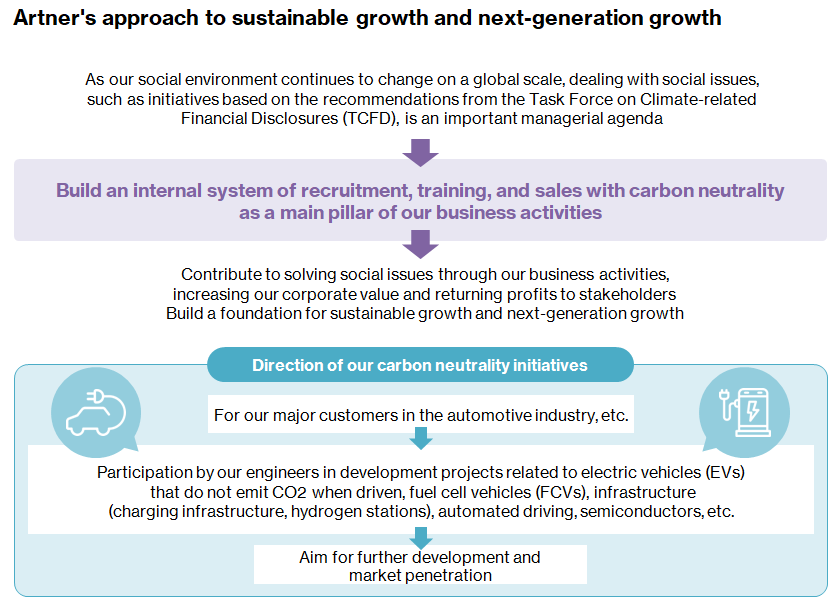
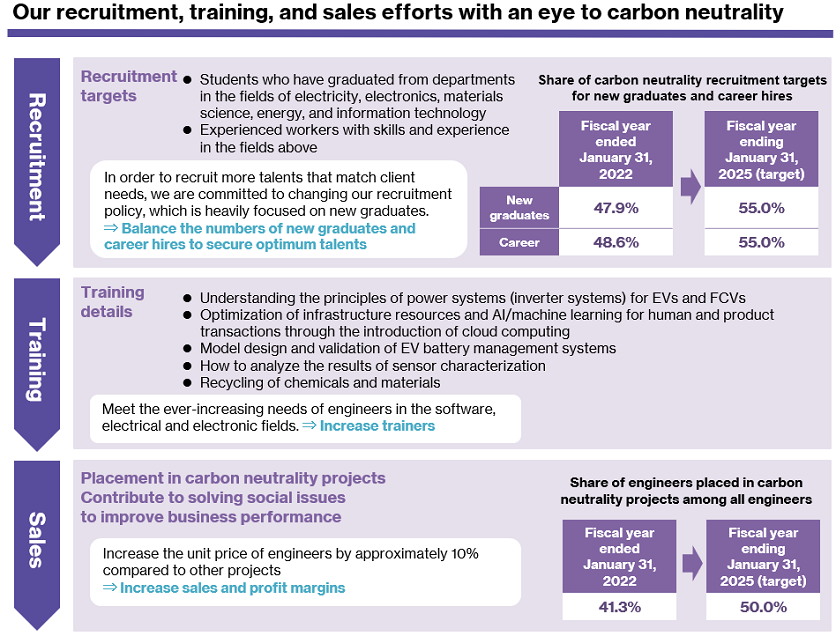
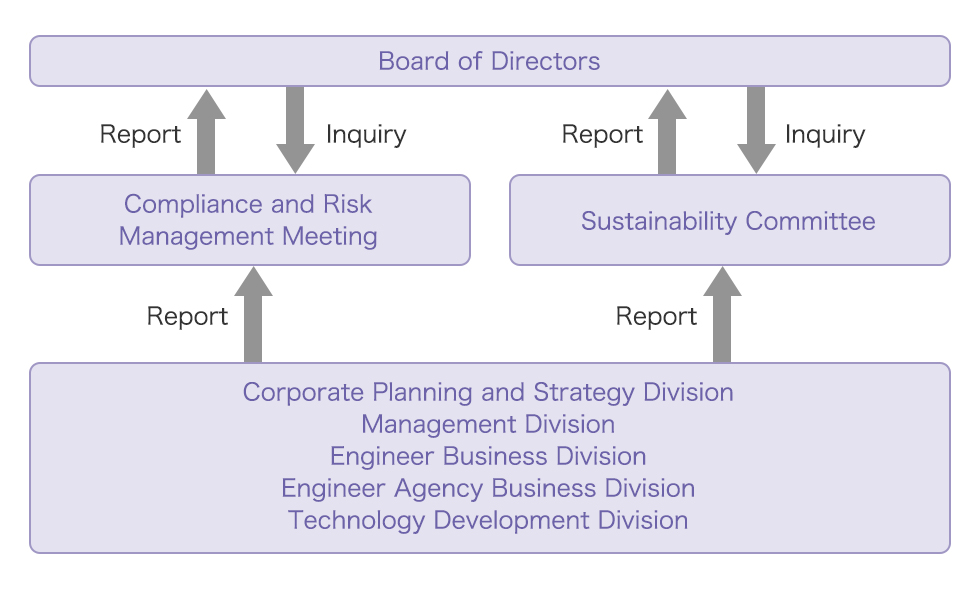
We will disclose information in accordance with the recommendations published by the Task Force on Climate-related Financial Disclosures (TCFD) of the Financial Stability Board (FSB). 》Governance 》Strategy |
| Risk item | Business impact | |||||||
|---|---|---|---|---|---|---|---|---|
| Large category | Medium category | Small category | Timeframe | Indicator | Consideration: risks | Consideration: opportunities | Evaluation (risks) |
Evaluation (opportunities) |
| Transition (1.5 and 2°C scenarios) |
Policies and regulations |
Carbon price (carbon tax) | Short- to long-term | Increased payment | The Company’s main business is the dispatching of engineers, and it has offices and training facilities to meet the needs of client companies. Therefore, if a carbon tax is introduced, there is a risk that overhead costs will increase with the use of electricity. | − | Medium | − |
| Renewable energy policy | Short- to long-term | Increased payment | There is a risk that expenditures will increase if the price of renewable energy rises due to the promotion of renewable energy policies resulting in an increased demand for renewable energy. | − | Medium | − | ||
| Energy-saving policy | Short- to long-term | Increased payment | The Company uses leased office space for its business and training facilities. There is a risk that the conversion of normal office buildings into net-zero energy buildings (ZEBs) will lead to an increase in expenditures because the cost of developing ZEBs will be added to the rent or the tenant fee. | − | Medium | − | ||
| Technology | Advances in low-carbon technologies | Short- to long-term | Increased earnings Increased payment |
Our main customers are in the automotive industry, which requires us to provide engineers who can develop products related to low-carbon technologies. If we are slower than our competitors to respond to these technologies, our engineers’ skills may be considered obsolete and the demand for the dispatch of engineers may shrink, resulting in decreased sales. If new technologies need to be incorporated, costs for information gathering and training may increase. | A low-carbon society may be promoted, which will lead to an increase in the demand for products using low-carbon technologies. In such a case, our sales may increase due to an increased demand for the dispatch of engineers to our existing clients and new clients. | Large | Large | |
| Market | Change in demand for important products | Short- to long-term | Increased earnings Increased payment |
Our main customers are in the automotive industry, which requires us to provide engineers who can develop products related to low-carbon technologies. If we are slower than our competitors to respond to these technologies, our engineers’ skills may be considered obsolete and the demand for the dispatch of engineers may shrink, resulting in decreased sales. If new technologies need to be incorporated, costs for information gathering and training may increase. | Since the Company’s main customers belong to the automotive industry, actively attracting engineers who can deal with the design and development processes that support the shift to zero-emission vehicles (ZEVs) may lead to increased demand for the dispatch of engineers, which could result in higher sales. The advancement of low-carbon technologies has accelerated the speed of development of low-carbon business. Enhancing our recruitment and training systems as well as our services to meet the increasing number of requests from clients could lead to increased sales. If extreme weather conditions increase, along with a rising demand for seasonal products such as air conditioning products that can deal with higher/lower outdoor temperatures, this may lead to the manufacturers’ increased demand for the development of HVAC equipment, resulting in growing demands for the dispatching of engineers and increased sales. | Medium | Large | |
| Reputation | Change in reputation from customers | Short- to long-term | Increased earnings Increased payment |
The momentum for decarbonization is growing throughout the supply chain. Clients may require their suppliers to reduce emissions and disclose relevant information. In particular, the automotive industry, which accounts for a major part of our customer base, is making much progress in this area than other industries. If our efforts are deemed insufficient, there is a risk that our reputation will be damaged, leading to a decrease in sales. In addition, significant costs may be required to address these issues. | As the entire supply chain of the automotive industry is making an effort to reduce emissions, if we become recognized as a leader in addressing climate change issues, this could lead to increased sales. | Large | Large | |
| Change in reputation of our employees | − | If the Company’s environmental initiatives and the track record for dispatching engineers who have low-carbon skills are highly regarded by job seekers, the Company’s image may improve, which could serve as an advantage over other companies in recruiting talents. | − | Large | ||||
| Change in reputation from investors | Short- to long-term | Increased earnings Increased payment |
The trend toward decarbonization may require investors to consider factors such as the decarbonization efforts and GHG emissions of companies that they invest in before making decisions, which may incur additional costs. | If factors such as environmental initiatives and GHG emissions become more important in making investment decisions, and if investors see that the Company’s environmental efforts are advanced, this may lead to a rise in the stock price and an inflow of investment capital. | Medium | Medium | ||
| Physical impact (4°C scenario) |
Acute | Intensifying extreme weather events (typhoons, torrential rains, landslides, storm surges, etc.) | Long-term | Increased payment | If our clients are adversely affected by increased natural disasters causing operation downtime, etc., our sales may decrease due to reduced demand for engineers as a result of R&D budget cutbacks. Also, in the event that our offices and training facilities are affected by such disasters, costs for recovery and relocation may be incurred. | − | Large | − |
| Chronic | Increased average temperature | Long-term | Increased payment | Rising average temperatures will increase the use of air conditioning, which may increase costs at all our business and training facilities. | If rising outdoor temperatures increase the need for safer and more comfortable indoor temperatures, the manufacturers’ demand for developing HVAC equipment will increase, which may result in an increased demand for the dispatching of our engineers and increased sales. | Small | Medium | |
| Risk item | Response | |||
|---|---|---|---|---|
| Large category | Medium category | Small category | Examples of our response to risks | Examples of our activities to achieve opportunities |
| Transition (1.5 and 2°C scenarios) | Policies and regulations | Carbon price (carbon tax) | Set GHG emission reduction targets Switch the rent-a-cars that we use to EVs and other low-carbon vehicles | |
| Renewable energy policy | Reduce electricity costs through energy conservation initiatives at our offices | |||
| Energy-saving policy | ||||
| Technology | Advances in low-carbon technologies | Capture demand for the development of low-carbon products such as EVs and other low-carbon vehicles, as well as energy-saving and renewable energy equipment, etc. | ||
| Market | Change in demand for important products | |||
| Reputation | Change in reputation from customers | Contribute to the development of customers’ low-carbon products by dispatching engineers with low-carbon skills Acquire new clients by strengthening the low-carbon skillsets of our engineers | ||
| Change in reputation of our employees | − | Provide a proven track record in the low-carbon business area | ||
| Change in reputation from investors | Contribute to the development of customers’ low-carbon products by dispatching engineers with low-carbon skills Acquire new clients by strengthening the low-carbon skillsets of our engineers | |||
| Physical impact (4°C scenario) | Acute | Intensifying extreme weather events (typhoons, torrential rains, landslides, storm surges, etc.) | Formulate a BCP in preparation for the potential occurrence of natural disasters | − |
| Chronic | Increased average temperature | − | Respond to the growing demand for the development of air conditioning products | |
Greenhouse gas (GHG) emissions (Scope 1 and Scope 2)
Unit: tCO2
| Description | Target | Result | |||||
|---|---|---|---|---|---|---|---|
| FY2051 | FY2025 | FY2024 | FY2023 | FY2022 | FY2021 | ||
| scope1 | Use of fuel for rent-a-cars | Net zero | 86.0 | 7.5 | 11.4 | 18.0 | 26.1 |
| scope2 | Use of electricity at our locations | 91.2 | 79.9 | 79.3 | 82.5 | ||
| Total | 98.7 | 91.3 | 97.3 | 108.6 | |||
*Fiscal year ended January 31

 ページ印刷
ページ印刷